
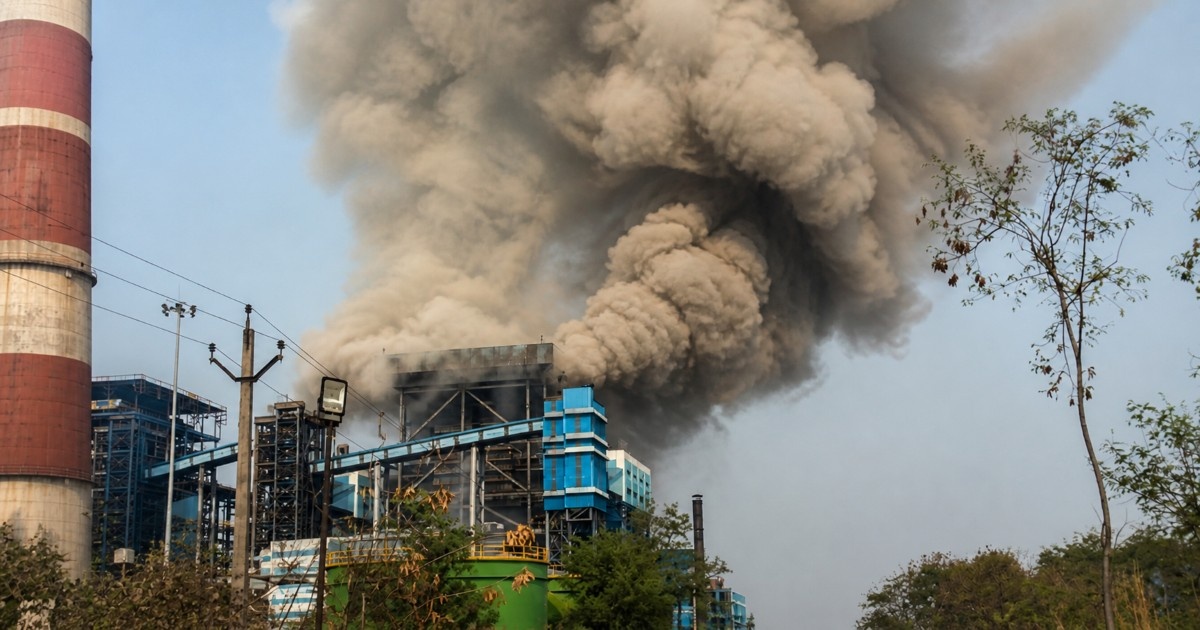
A boiler explosion occurred at the power plant in Singhitarai village, Sakti district, Chhattisgarh, on April 14, 2026, killing 20+ workers and injuring 35+ others.
Location: Boiler Unit-1 of the 1,200 MW coal-fired thermal plant in Singhitarai, Sakti district.
Casualties: 20+ deaths (4 instant, 16 from injuries in Raigarh and Raipur hospitals); victims from Chhattisgarh and neighboring states.
Analyzing failure points and preventive lessons
Boilers work under extremely high pressure and temperature, which makes them inherently hazardous systems. This incident emphasizes the need for strict safety practices and strong operational discipline.
It points to potential gaps in maintenance, monitoring systems, and decision-making processes. Such events result in the loss of experienced workforce and interruption in power generation.
Overall, it serves as a serious warning for all thermal power plants to strengthen safety measures.
-
To determine the engineering and technical causes of the boiler explosion.
-
To understand operator mistakes and gaps in plant operations.
-
To examine breakdowns in safety systems and warning signals.
-
To suggest practical and applicable preventive measures for engineers and operators.
-
To improve overall plant safety, system reliability, and future risk control.
What Went Wrong
Critical safety lapses, undermining the need for strict maintenance, regular inspections
Aggressive Load Ramp-Up
The plant load was rapidly increased from about 350 MW to 590 MW within a short period.
This forced the boiler to produce a large amount of steam instantly, without proper stabilization.
As a result, the temperature and pressure inside the system rose sharply.
This caused high thermal and mechanical stress on important boiler components.
The recommended gradual load increase (ramp rate) procedure was not properly followed.
The Shift from 350 MW to 590 MW
A ~240 MW jump is a very high change for a running unit. Normally, load should be increased step-by-step to allow system stabilization.
Sudden ramp-up disturbs:
Fuel-air balance
Steam temperature control
Drum level stability
This creates an unstable and risky operating condition.
The investigation suggests that sharp load ramp-up created excessive stress on boiler components.
This stress becomes more dangerous when:
Equipment is aging
Operating near design limits
High stress can lead to:
Tube weakening
Crack formation
Sudden failure
A sudden load increase of about 240 MW at the plant in Chhattisgarh can be compared to a thermal shock condition.
A rapid rise in load leads to a quick increase in furnace temperature and steam pressure.
Boiler components such as tubes, headers, and steam lines heat up and expand in a non-uniform way.
This uneven expansion creates high internal thermal stress in the metal parts.
At the same time, the rise in pressure adds additional mechanical stress on the system.
There is not enough time for proper heat and pressure balance (stabilization).
This is an abnormal operating condition rather than a standard one.
It significantly increases the risk of tube rupture, leakage, or even explosion.
Failure of Critical Equipment (PA Fan)
The Primary Air (PA) fan reportedly malfunctioned multiple times during operation at the plant.
A PA fan is essential for supplying air to carry coal and support combustion, Its failure directly disturbed the air–fuel ratio inside the furnace, Despite repeated issues, the unit was kept in operation.
The Ignored Alarm: PA Fan Malfunction
Multiple warnings and alarms were generated between morning and early afternoon.
-
These alarms indicated abnormal PA fan performance
-
However, corrective action was delayed or ignored
-
Continued operation under faulty conditions increased system instability
The Critical Link: Air–Fuel Ratio
For safe and efficient combustion, a boiler requires a proper balance between air and fuel.
In this situation:
Primary air supply was reduced due to a PA fan issue.
At the same time, coal input was increased to reach around 590 MW load.
-
This created a dangerous imbalance in the combustion process.
-
Due to insufficient air, the coal did not burn completely (incomplete combustion).
-
As a result, unburnt fuel began to accumulate inside the furnace.
-
This accumulated fuel can suddenly ignite, leading to a rapid pressure rise and possible explosion.
Ignored Warning Signals
At the plant in Chhattisgarh, several alarms and abnormal readings were reportedly ignored, Critical signs like PA fan faults, unstable combustion, and pressure/temperature fluctuations were not addressed in time.
-
Decision-making failures delayed shutdown or corrective action.
-
Production demand was prioritized over safety procedures.
-
Continued operation under unsafe conditions gradually increased the risk of failure.
Air–Fuel Imbalance & Combustion Instability
-
Incomplete combustion occurred due to insufficient primary air
-
Coal was not fully burnt and started accumulating inside the furnace
-
This created a highly unstable and explosive environment
The Invisible Trap: Unburnt Fuel & Furnace Pressure Buildup
Investigation findings indicate unbalanced combustion leading to excessive pressure buildup.
When fuel does not burn properly, it forms unburnt coal dust and volatile gases.
These materials get trapped in:
Furnace bottom area
Burner zones
Flue gas ducts
The Mechanism
Unburnt coal dust is highly combustible.
Due to low air supply, this dust keeps accumulating instead of burning.
Over time, a fuel-rich zone develops inside the furnace
At the same time:
Pressure starts increasing
Temperature remains uneven
Now the system is in a dangerous waiting state
Any small trigger can set it off:
Sudden air entry
Hot surface or spark
Pressure fluctuation
This leads to rapid ignition of accumulated fuel → sudden pressure rise → explosion.
Pressure Build-Up Inside Furnace
At the Chhattisgarh plant, combustion instability led to abnormal furnace pressure rise, Unburnt fuel + uneven combustion caused sudden release of heat and gases.
This increased internal furnace pressure beyond safe limits.
Failure of Pressure Relief / Safety Mechanisms
Safety systems like furnace pressure control, dampers, and relief paths did not respond effectively
Possible reasons:
Delayed action
Malfunction
Or a system being unable to handle rapid pressure rise.
As a result, excess pressure was not released in time.
Unsafe operating envelope breached
Boilers are designed to operate within defined pressure and temperature limits. Due to continuous instability, system pressure went beyond safe limits. The boiler entered an unsafe operating zone.
At this stage, the condition became critical and difficult to control.
Structural Failure (Pipe Rupture)
At the plant in Chhattisgarh, a rupture in the bottom ring header pipe was reported during the incident.
This failure was a secondary effect, not the main cause of the accident.
However, it acted as a trigger point, quickly intensifying the situation into a major explosion.
The Symptom vs. The Cause: Ruptured Bottom Ring Header
The investigation indicates that the pipe rupture was a consequence, not the root cause, Due to severe combustion instability and pressure build-up, the system had already reached a critical condition.
The bottom ring header, being part of high-pressure circulation, failed under this extreme stress.
The Narrative Shift
Early reports may describe the incident as a “pipe burst accident.”
However, this can be misleading if considered the main cause.
Actual sequence:
Combustion imbalance → Furnace pressure build-up → System instability
Pressure increased beyond safe design limits.
As a result, the pipe ruptured due to excessive internal stress.
Maintenance & Safety Lapses
The incident highlights gaps in routine maintenance and safety practices.
Critical systems (like PA fans, pressure parts, and monitoring instruments) may not have been inspected or tested thoroughly, Early signs of abnormal operation were not detected or not acted upon effectively.
Inadequate Inspection of Critical Systems
Checks of:
Boiler tubes and headers
Fans and combustion systems
Sensors and transmitters
were likely insufficient or not timely.
This increases the risk of undetected faults during operation.
Possible Failure of Interlocks & Trip Systems
Safety systems such as Boiler protection interlocks
Automatic trip mechanisms may have:
Failed to activate
Been delayed
Or possibly bypassed
These systems are designed to shut down the plant automatically in unsafe conditions
Weak Adherence to SOPs & Safety Audits
Standard Operating Procedures (SOPs) may not have been strictly followed.
Safety audits and checks might have been:
Irregular / not properly implemented.
Operational decisions may have prioritized production over safety.
Organizational & Management Failures
The incident at the Chhattisgarh plant indicates system-level management issues.
Production targets were given priority over safety, especially during high load demand, Risk evaluation practices were inadequate, and warning signs were not treated as serious. Responsibility and reporting procedures were not properly followed.
The Systemic Void: Disabled/Inadequate Safety Devices
Evidence indicates gaps in maintenance and operating procedures, Important safety systems such as the Furnace Safeguard Supervisory System (FSSS) and Master Fuel Trip (MFT) did not respond properly.
These protection systems failed to act effectively during hazardous conditions.
The Crucial Question
When:
PA fan malfunctioned, and
Furnace pressure increased abnormally
The system should have automatically tripped the boiler.
However, this did not happen due to:
Possible system failure
Delayed response
Or manual override / bypass
How It Could Have Been Prevented
This accident could have been prevented with Strict Load Management Protocols
Gradual Ramp-Up Procedures
At the plant, the lack of controlled load increase contributed to system instability, Load should always be increased gradually, not suddenly.
Follow pre-set ramp rate limits (MW per minute) based on boiler design.
How Proper Ramp-Up Should Be Done, Increase load in small, controlled steps.
Under the Central Electricity Authority (CEA) 2023 Regulations, coal-based thermal power units must follow defined load increase rates based on their operating range:
-
70% to 100% Load: At least 3% load increase per minute
-
55% to 70% Load: At least 2% load increase per minute
-
40% to 55% Load: At least 1% load increase per minute
Allow sufficient time at each step for:
Temperature stabilization
Pressure balance
Steam parameter control
Continuously monitor:
Furnace conditions
Drum level
Steam temperature and pressure
Real-Time Stress Monitoring & Load Control
Insufficient monitoring and control increased operational risk. Use continuous monitoring systems to track temperature, pressure, and metal stress in real time.
Install automatic load-limiting protection to avoid unsafe load increases.
Always follow boiler ramp rate limits (typically 3–5% per minute).
Preventive Actions
Enforce design ramp rate limits without exception.
Apply a Zero Override Policy, no production target should bypass safety limits.
The system should automatically:
Stop further load increase, or
Reduce load if safety limits are exceeded
Robust Equipment Maintenance
Preventive & Predictive Maintenance (PA Fans)
Preventive maintenance involves regular checking, cleaning, lubrication, and timely replacement of parts before failure occurs, Predictive maintenance uses data such as vibration, temperature, and current to identify issues at an early stage
Vibration & Performance Monitoring
Sensors continuously track vibration, motor current, speed, and airflow.
Abnormal readings indicate issues like imbalance or damage.
Early warnings help prevent equipment failure.
Immediate Shutdown on Repeated Failure
If equipment fails again and again, it means a serious issue exists, Continuing operation under such conditions is highly unsafe.
The correct action is:
Stop the unit immediately, Fix the root cause before restarting.
Enforced Safety Interlocks & Trip Systems
Safety systems did not respond effectively, Boilers must trip automatically during unsafe conditions (air–fuel imbalance, PA fan failure, high pressure). No manual override of interlocks without strict authorization.
Tripping Logic & Alarm Discipline
Rule: PA Fan Trip = Boiler Trip (no exception).
Repeated faults should trigger immediate shutdown.
Operators must have authority to stop unsafe operations.
Furnace Pressure Protection & MFT
High furnace pressure → MFT activates instantly.
Cuts off fuel and prevents explosion.
Furnace Purging
After flame failure, purge the furnace (~5 minutes).
Removes unburnt fuel and explosive gases.
Skipping purge greatly increases explosion risk.
Real-Time Monitoring & Automation
Weak monitoring and slow response increased failure risk.
Advanced Control Systems (DCS/SCADA)
Systems like DCS and SCADA continuously track:
Temperature
Pressure
Air–fuel ratio
Equipment performance
With analytics, they detect abnormal trends early before failure occurs.
Example: Rising furnace pressure or unstable combustion can be identified in real time.
Alarm Prioritization
Power plants can generate hundreds of alarms at once.
Without prioritization, critical warnings may be missed.
A proper system should:
Highlight high-risk alarms (e.g., PA fan failure, high pressure)
Reduce low-priority or nuisance alarms
Strong Safety Culture in Power Plant
Operators must stop operations in unsafe conditions without hesitation, All alarms must be acted upon, not ignored, Safety KPIs are as important as production KPIs.
SIL safety systems must always be active and reliable.
Regular testing of critical devices (pressure switches, flame scanners) is required.
Safety systems must never be bypassed or disabled during operation.
Preventive Action
Regular calibration ensures accurate readings of instruments.
Regular functional testing checks whether systems are working properly.
This ensures safety systems are always ready for operation.
Dangerous Practice: Bypass / Defeat Mode
If a safety device is put in “bypass” or “defeat” mode only to keep the plant running, it means the protection system is intentionally disabled. This is sometimes done to avoid production shutdown, but it is extremely unsafe.
In such cases, safety protection is not available during an emergency.
This practice is highly dangerous and strictly prohibited.
It is treated as a serious safety violation and can have legal consequences.
Training & Competency Development
Regular training for operators on emergency response and safe operations, Simulation drills for critical situations like boiler trips and plant failures, Hands-on exposure to improve quick decision-making during emergencies.
Certification required before handling high-load or critical operations.
Only trained and competent personnel should be allowed for high-risk tasks.
Independent Safety Audits & MOC
Third-party audits of critical systems like boilers for unbiased safety evaluation, Regular compliance checks with regulatory and industry safety standards.Transparent reporting of defects, risks, and audit findings without suppression.
Management of Change (MOC) Process
Any change in operating conditions (e.g., running at 590 MW beyond rated capacity) must go through a formal MOC review.
Engineering evaluation is required before implementing higher load or process changes.
MOC helps identify risks like equipment limitations (e.g., PA fan capacity issues).
It also highlights possible stress on critical components like the bottom ring header.
Proper MOC prevents unsafe operation by addressing risks before the shift begins.
Emergency Preparedness
Clear evacuation procedures for all areas of the plant.
Fully functional emergency shutdown (ESD) systems for quick isolation.
On-site medical facility with trained first-aid support.
Dedicated rapid response teams for fire, explosion, or major incidents.
Regular emergency drills to ensure preparedness in real situations.
Key Lessons for the Power Sector & Energy Industry
Small warnings matter:
Early signs like alarms, pressure changes, or abnormal readings should never be ignored, as they often indicate a developing problem.
Equipment and human error is dangerous:
Technical faults alone may be manageable, but when combined with wrong actions or delayed decisions, they can lead to serious accidents.
Safety systems must be followed:
Protection systems like alarms and interlocks are effective only when properly used and not bypassed or ignored.
Safety culture is critical:
A strong focus on safety at every level of the organization is as important as engineering design for preventing accidents.
Conclusion
The incident highlights a combined failure of technical systems, human actions, and management decisions. Equipment stress conditions, operational deviations, and delayed responses together contributed to the escalation of risk.
It strongly emphasizes the need for clear accountability and stronger system-level improvements in plant operations. There is a clear requirement for strict regulatory monitoring and enforcement of safety standards.
Overall, the focus must shift toward safety-first operations over production pressure to prevent such incidents in the future.