
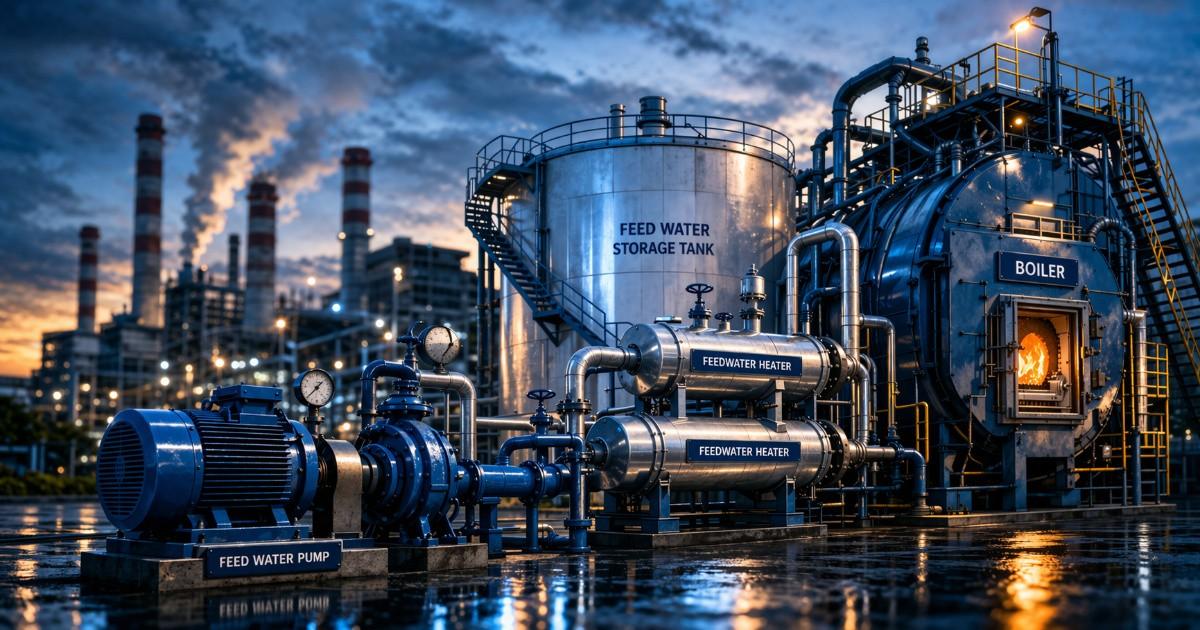
Boiler feed water systems play an important role in power plants by supplying purified water (Treated Water) to the boiler for steam generation in the rankine cycle.
These systems consist of components such as feed pump, preheaters, and storage tank (Deaerator), which perform water purification, pressure boosting, and initial heating before it enters the boiler.
Role of feed water in the Rankine cycle
The Rankine Cycle is the primary operating cycle of steam power plants. Feedwater has an important role in this process, as it acts as the main fluid that continuously flows through the system to generate power.
Feed water serves as the primary fluid that absorbs heat in the boiler and transforms into steam. This steam drives the turbine to generate electricity.
After the expansion process, it is cooled and converted back into water, which is then recirculated, maintaining a continuous cycle.
-
Medium for Heat Absorption
-
Energy Transfer Agent
-
Maintains Continuous Cycle
-
Prevent Damage to Equipment
-
Maintains Pressure and Temperature
Importance of feed water quality and flow control
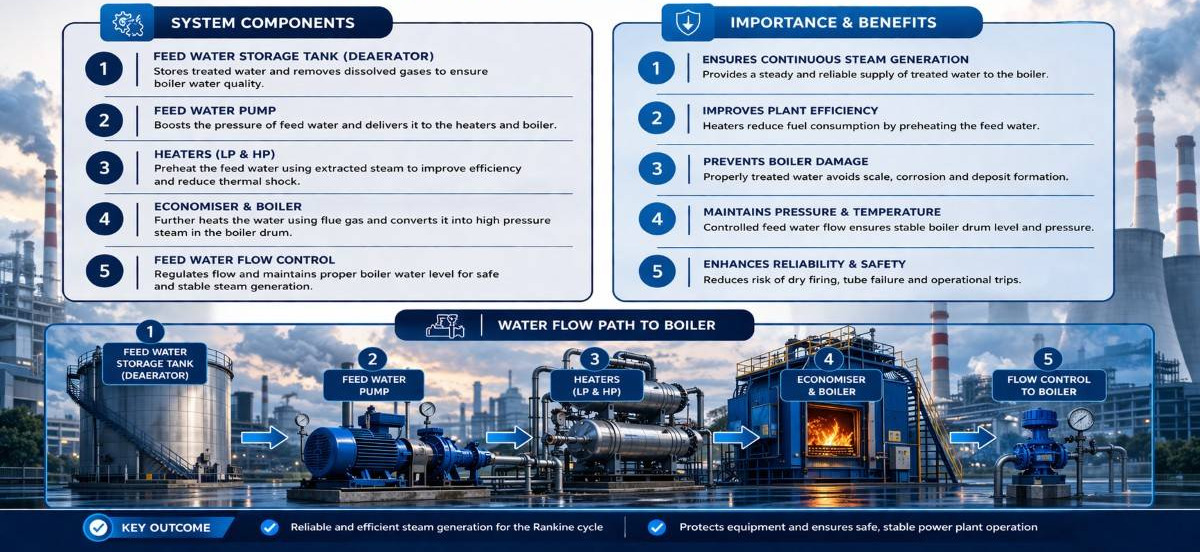
Properly treated feedwater helps avoid scale formation, corrosion, and deposit buildup inside boiler tubes.
It increases equipment life and lowers maintenance expenses. Clean and purified water also supports effective heat transfer and ensures reliable and safe operation of the system.
Accurate flow control regulates the required water level in the boiler. It helps maintain stable steam generation and prevents problems such as operation without water or overfilling.
A well controlled flow enhances overall efficiency and improves system reliability.
Water Cycle & Steam Circuit in Thermal Power Plant
The Rankine cycle represents a close loop system where water is continuously converted into steam and back into the water.
Overview of the Complete Water Steam Loop
Condensation : Used steam from the turbine is cooled in the condenser and turned back into water.
Pumping : A feed water pump boosts the pressure of this water.
Heating : The water flows through heaters and the economiser to increase its temperature.
Steam Generation : Inside the boiler, the heated water is converted into pressurised steam.
Power Generation : This steam expands in the turbine, producing mechanical power, the turbine shaft connected to the generator to generate electrical output.
Recycling : The steam is again condensed and recirculated, completing the cycle.
Key Components
-
Condenser : Converts exhaust steam into water.
-
Feed Pump : Increases pressure of feedwater
-
Heaters : Preheat the water using extracted steam
-
Economiser : Uses flue gas heat to warm feed water
-
Boiler Drum : Separates steam and water
-
Superheater : Converts saturated steam into superheated steam
-
Turbine : Expands steam to produce mechanical power
Flow Path & Pressure Enthalpy Changes
-
Pump Stage : Pressure increases, slight rise in enthalpy.
-
Boiler Stage : There is a significant rise in enthalpy as water is converted into steam.
-
Superheating : Enthalpy continues to increase while the pressure remains constant.
-
Turbine Stage : Both pressure and enthalpy decrease as energy is generated.
-
Condensation : Enthalpy drops further as steam returns to liquid form.
Close Loop Cycle Description
In the Rankine Cycle, water flows in a closed loop cycle throughout the system. Steam leaving the turbine is cooled and converted back into water, which is then recirculated as feedwater. This constant reuse of water helps reduce overall consumption and stable plant operation.
Losses and Make up Water Addition
-
Small losses occur due to leakages, blowdown, and steam usage.
-
To maintain balance, make-up water is added to the system.
-
This water is treated before entering the cycle to maintain quality.
Role of Condensate Polishing and Blowdown
Condensate Polishing : This process eliminates contaminants from the condensate water, maintaining high water quality before it is recirculated into the system.
Blowdown : Boiler Blowdown removes dissolved solids and impurities from the boiler water to avoid scale formation and corrosion, ensuring efficient and safe operation
Feed Water Pump in Steam Power Plant
The feed water pump is an important component in the power plants. It supplies high pressure water to the boiler, ensuring continuous steam generation.
Types of Feedwater Pumps
-
Centrifugal Pump : These pumps are essential rotating equipment that transform kinetic energy into hydraulic pressure, primarily used to handle large quantities of liquids, including water, fuel, and lubricating oil.
-
Multistage Pump : These pumps are high pressure, centrifugal machines that use multiple impellers arranged in series to boost liquid pressure.
-
Booster Pump : These pumps are specifically designed as a centrifugal unit used to boost the pressure of liquid, usually boiler feedwater, before it passes into the main high pressure pump (BFP).
Pump Sizing, Head Requirements, and NPSH considerations
Pump sizing is selected based on the desired flow rate and overall system demand to maintain an uninterrupted supply of feed water.
The pump must provide adequate head to overcome boiler pressure as well as frictional and elevation losses within the system.
Net Positive Suction Head (NPSH) is a key parameter, as it maintains sufficient suction pressure at the pump inlet, helping to avoid cavitation and ensure reliable and efficient operation.
Operational Challenges and Redundancy
Challenges :
-
Cavitation (Low Suction Pressure)
-
Overheating
-
Vibration
-
Seal Failures (Leakage)
Redundancy :
-
Power plants use a duty/ standby configuration to ensure reliable operation, where one pump operates continuously while the other remains as a standby unit.
-
If the primary pump malfunctions (fails), The standby pump automatically comes into service, helping to ensure continuous operation without interruption.
Boiler Feed Water Heater System
Feedwater heaters are utilized in the Rankine Cycle to raise the temperature of water before it enters the boiler.
Low-pressure (LP) Heaters
A Low Pressure feedwater heater located before Boiler Feed Pump/Deaerator and utilises steam extracted at low pressure to raise the temperature of condensate before it is further processed.
High-pressure (HP) Heaters
A High Pressure feed water heater located after Boiler Feed Pump and utilises steam extracted at high pressure to provide additional heating to the feedwater b before it enters the boiler.
Extraction steam from turbine as heating source
In thermal power plants, some amount of the steam is bled from the intermediate stage of the turbine and used to heat the feedwater in heaters.
Impact on cycle efficiency and thermal stress reduction
Improves Efficiency : Preheating feedwater reduces fuel consumption in the boiler.
Reduces Thermal Stress : Gradual heating prevents sudden temperature changes in components.
Boiler Feed Water Temperature in Power Plant
Typical Temperature Ranges and Control Strategies
Feedwater temperature is usually maintained between 100℃ to 250℃, depending on the plant configuration. It is regulated using LP and HP heaters, a deaerator, and control valves to maintain stable and reliable operation of the system.
Relationship with boiler efficiency and flue gas dew point
A higher feed water temperature enhances boiler efficiency by reducing fuel consumption . It also maintains the exhaust gas temperature above acid dew point, helping to avoid corrosion on the heat transfer surface.
Effects on thermal shock and startup procedure
Maintaining the correct temperature prevents thermal stress in boiler components. During startup, controlled and gradual heating is essential to avoid damage caused by rapid temperature variation.
Feed Water as an Attemperator in Power Plant
Attemperation (Desuperheating) using feed water
Feedwater is also used to control the temperature of superheated steam by spraying a small amount into the steam line. This process controls steam temperature without significantly affecting pressure.
Type of Attemperators
-
Spray Type : Directly sprays feedwater into steam for quick cooling.
-
Surface Type : Uses heat exchange without direct mixing of water and steam.
Control of superheater/reheater outlet temperature
The outlet temperature of the superheater and reheater is carefully regulated to protect the turbine and ensure efficient operation. This is primarily achieved through attemperation, where a controlled amount of feedwater is sprayed into the steam to lower its temperature.
Regulating valves automatically adjust the spray flow based on temperature feedback, helping to maintain the required setpoint.
Feed Water Storage Tank in Thermal Power Plant
Purpose of the storage tank
Deaerator Feed Tank : In thermal power plants this tank serves as an essential reservoir for treated feedwater. Its main function is to remove dissolved gases such as Oxygen and Carbon dioxide, helping to protect boilers and piping from corrosion.
It also preheated water and acts as a buffer, ensuring a stable and continuous feedwater supply to the system.
Separate Tank : This tank is used in thermal power plant designs to enhance reliability, flexibility, and control of the water system. Although many plants use a combined with deaerator tank, a separate tank provides additional operational benefits.
Level control
The water level in the tank is continuously monitored and regulated using level transmitters and control valves. This helps maintain a proper balance between incoming and outgoing flow and protects pumps from dry running and cavitation, ensuring safe and reliable operation.
Surge Capacity
This tank works as a stabilising reservoir to handle rapid changes in system demand or supply. It helps absorb fluctuation caused by turbine load variations, changes in boiler demand, and during startup and shutdown conditions, ensuring stable smooth system operation.
Emergency Supply
In the event of a pump malfunction or upstream disturbances, the tank as a temporary water reserve to :
-
Maintain safe boiler operation
-
Provide time for corrective measures
-
Reduce the risk of sudden or unexpected shutdown
Conclusion and System Integration
In a thermal power plant, the feedwater system operates as an interconnected unit, where the pump, heaters, storage tank, and attemperation system work together to ensure stable performance and proper monitoring maintenance and control practices provide operational safety and long term equipment reliability.
Interdependence of pump, heater, storage, and attemperation
In thermal power plants, the pump, heaters, storage tank, and attemperation system are interconnected.
The storage tank provides a steady water supply to the pumps, while the pumps maintain the required pressure.
The heaters raise the water temperature to improve efficiency, and attemperation utilises feedwater to regulate steam temperature.
Any changes in one component can influence the flow, so effective coordination is necessary for stable and reliable operation.
Best practices for reliable boiler feed water system operation
-
Maintain proper water level in the storage tank
-
Ensure pump protection and stable suction
-
Monitor heater performance regularly
-
Control attemperation accurately
-
Maintain water quality and perform regular maintenance