
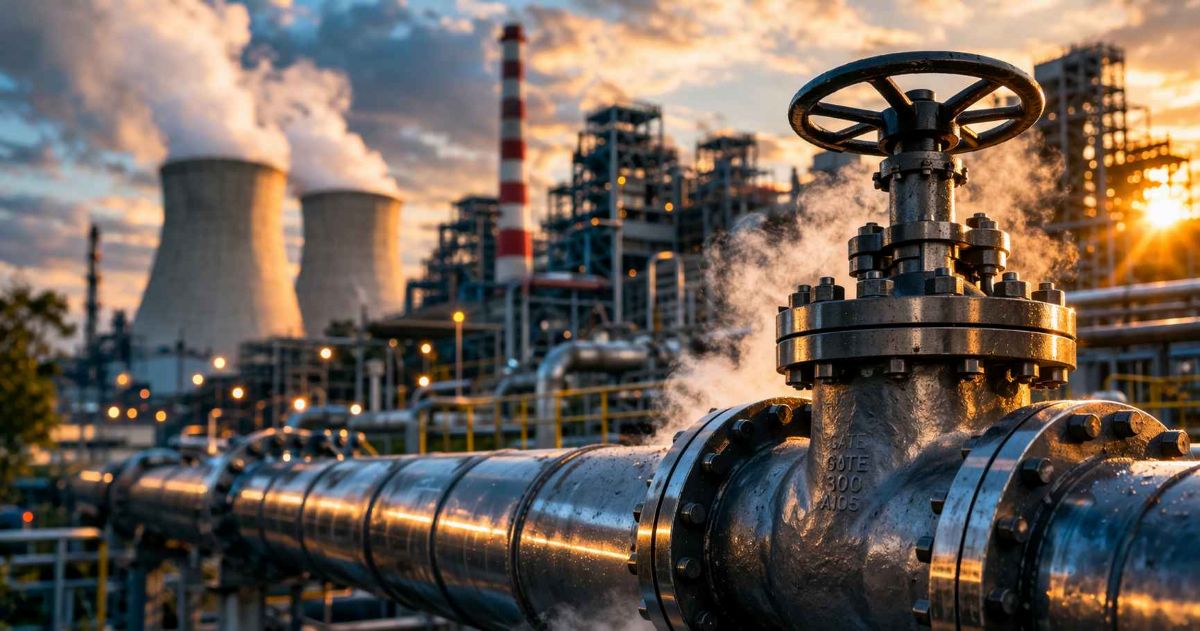
In thermal power plants, valves play an important role. They regulate , control and isolate fluids like water, steam, oil, or gas. Valve reliability under high temperature and high pressure conditions affects both system safety and efficiency.
Classification of Power Plant Valves by Function
Isolation Valves
Completely Turn ON or Turn OFF the Flow. Common Types include Gate Valve, Ball Valve, Butterfly Valve
Control Valves
Regulating Flow rate, Pressure and Temperature. Common Types include Globe Valve, Control Valve (with Actuator)
Safety and Pressure Relief Valves
Protecting the system from Overpressure. Common Types include Safety Valve, PRV
Non Return Valves (NRV)
Stopping Reverse Flow. Common Types include Check Valve, Swing Check Valve
Key Types of Valves
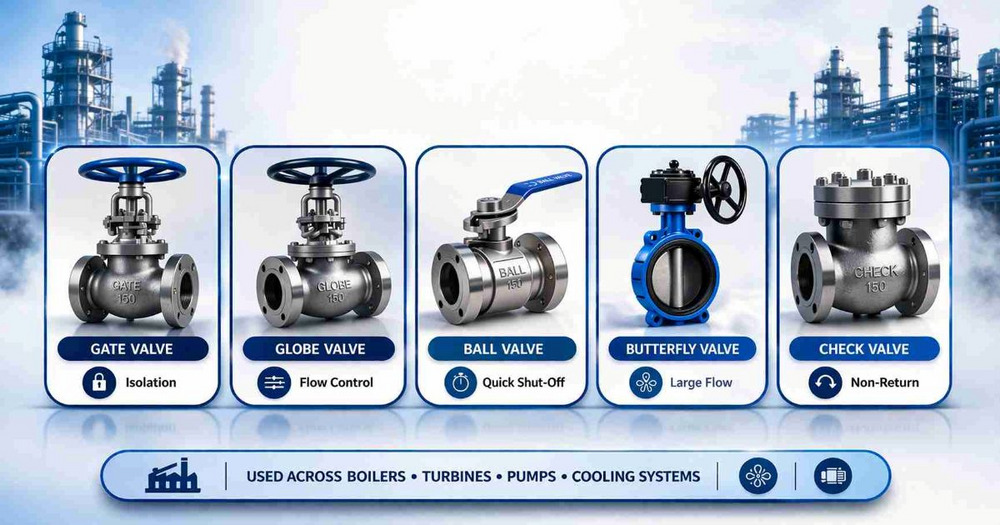
Gate Valve
It is an isolation valve used to completely open or close the flow of fluid (steam or water) . In thermal power plants, these valves are known for their reliable operation under high pressure and temperature conditions.
Applications in Main Steam & Feedwater Line
-
For isolation in the main steam line.
-
Steam supply control (ON/OFF) from boiler to the turbine.
-
During pump maintenance in the feedwater pipelines.
-
Section isolation in high pressure pipelines.
-
To stop flow in emergency shutdown conditions.
Advantages for High Pressure Isolation
-
Low Pressure Drop: When fully open, there is very low resistance to flow.
-
Tight Sealing: Leakage is almost zero.
-
High Pressure Handling: Suitable for boilers and steam lines.
-
Durability: Long service life.
-
Bidirectional Flow: Works in both directions.
Globe Valve
It is a control valve used to regulate (throttle) the flow of a fluid (steam, Water, oil). It plays an important role in thermal power plants where accurate flow and pressure regulation are required.
Role in Regulation Flow
-
Primary function is flow control (throttling)
-
Adjust flow rate precisely
-
Help control pressure and temperature
-
Stable operation even with partial opening
Usage in Bypass System & Instrumentation
-
Globe valve is installed in a bypass line parallel to the main line
-
Gradually flow control during startup and shutdown
-
Provide equipment protection through pressure balancing
-
Used with pressure gauges and sensors
-
Provide Accurate control in small flow line
-
Used in sampling line and drain line
Ball Valve
This valve is a quarter turn isolation valve that quickly and reliably ON/OFF the fluid flow (water, steam, oil, gas). It consists of a spherical ball (round disc) with a hole in it, which rotates to allow or block flow.
Quick Shut-Off Capabilities
-
The biggest advantage of this valve is instant shut-off
-
Complete close/open in 90° rotation
-
Fast response in emergency situation
-
Leakage almost zero
-
Remote control possible using actuator with automation
Metal-seated vs. Soft-Seated Variants
|
Feature |
Metal-Seated |
Soft-Seated |
|
Common Materials |
Stainless Steel, Stellite, (robust metal) |
Non Metallic material (PTFE, RPTFE, PEEK) |
|
Sealing Performance |
High Performance (but may have minor leaks) |
Superior (Bubble-tight/ zero leakage ) |
|
Operating Torque |
Higher (requires more force/actuation) |
Lower (Easier to turn) |
|
Durability |
Extremely high (resist erosion and abrasion) |
Lower in abrasive/dirty fluids |
Butterfly valve
It is a simple design, lightweight, compact and quarter-turn valve used to control or isolate the flow of fluid, making it widely used in large diameter pipelines (cooling water and air system).
Large Diameter Application (Cooling Water and Air system)
-
Air handling & ventilation ducts
-
Condenser cooling Water line
-
Circulating water system in power plant
Wafer Type vs. Lug- Type Designs
These Valves (wafer type and lug type) butterfly valves differ primarily in their mounting method and maintenance.
|
Feature |
Wafer Type Butterfly Valve |
Lug Type Butterfly Valve |
|
Mounting |
Fitted between two flanges using bolts |
It has threaded lugs that allow it to be belated to each flange separately |
|
Maintenance |
Required full shutdown |
Allows downstream removal under pressure |
|
Cost |
More economical |
Higher due to extra material |
Check Valves
This valve, also called an NRV (Non Return Valve), is an automatic valve that allows fluid to flow in one direction only and prevent reverse flow. In thermal power plants, it protects pumps, Pipelines from damage.
Swing Check Valve
It is a self activated valve, NRV valve that allows fluid in only one direction using a hinged disc that swings off the seat with forward flow and closes when flow stops to prevent reverse flow.
Features: Low pressure drop, Simple Design, Used for Large Pipelines
Applications: Cooling water lines, Low velocity fluid system
Lift Check Valve
It is a type of non return valve that permits fluid flow in one direction by raising a disc or ball off its seat, and it automatically closes when the flow reverses . It is well suitable for high pressure and high velocity clean fluid systems.
Features: Better sealing than swing type, suitable for high pressure system, Fast closing response
Applications: Steam line, Feedwater system
Dual Plate (wafer) Check Valve
This valve is a compact non return valve that uses two spring loaded discs to allow forward flow and quickly close to stop reverse flow and reduce water hammer. Installed between two flanges, they are lightweight, space efficient and suitable for both liquid and gas systems.
Features: Compact and Lightweight Design, Fast Closing.
Applications: High Velocity Pipelines, Pump Discharge Line, space limited area.
Control Valve
This valve is an automatic regulating device that controls process parameters such as flow, pressure, and temperature. These valves generally operate based on signals from a DCS (Distributed Control System) or PLC and maintain power plant stability.
Cage-Guided vs. Stem-Guided Designs
Cage-guided and Stem-guided describe how the valve internal plug is supported and kept aligned during its movement.
|
Features |
Cage-guided Design |
Stem-guided Design |
|
Stability |
High (resist lateral force) |
Lower |
|
Maintenance |
Quick Change |
Simple (may require full disassembly) |
|
Fluid Type |
Clean (liquid/gases) |
Better for viscous or dirty fluid |
Actuation and Positioner Integration
-
Control valves are used actuators and positioners to automatically adjust valve opening based on control signals.
Actuator
-
Types: Pneumatic, Electric, Hydraulic
-
Opening/closing the valve based on a control signal
-
Provide Fast and accurate response
Positioner
-
Accurately maintains the valve position
-
Correct valve opening through a feedback system
-
Improves control accuracy and stability
Safety Valve and Pressure Relief Valve (PRV)
It is important safety devices that protect the system from overpressure conditions. In thermal power plants, these valves ensure the safety of the boiler, steam and pressure vessels.
Drum Safety Valves
-
Installation: Boiler Drum
-
Maintaining pressure within the boiler a safe limit
-
Releasing steam in case of overpressure
-
Features: High reliability, Fast response time
-
Applistions: Steam Drum of Boiler
Superheater Outlet Safety Valves
-
Installation: Superheater Outlet
-
Protecting superheated steam from overpressure
-
Protecting turbine and downstream equipment from damage
-
Features: High temperature resistant design, Suitable for continuous high pressure operation, Accurate pressure setting
-
Applications: Superheater outlet steam line, Turbine inlet protection
Specialised Valves for Critical Power Plant Systems
Turbine Bypass Valve
This valve is a special valve used in power plants to divert steam away from the turbine during startup and shutdown, or emergency trips.
It helps protect the turbine blades from high pressure and temperature by sending steam directly to the condenser.
Primary Function
-
Plant startup/shutdown management
-
Protection against trips
-
Steam conditioning
Soot Blower Valve
This valve is used in thermal power plants to control the flow of high pressure steam or air supplied to soot blowers.
They regulate the cleaning process of boiler tubes, helping remove ash and slag deposits, which improves heat transfer and prevents overheating.
Primary Function
-
Control and reduce high pressure steam to the required cleaning pressure and flow.
-
Manage precise start and stop of the cleaning medium during operation
-
Ensure tight shutoff to prevent steam or air leakage when the soot blower is not operating.
Sampling System Valves (Needle Valve)
In thermal power plants this type of valve is used to safely take steam or water samples for testing. These valves (like globe, needle type) handle high pressure and temperature, then reduce them to safe levels.
Needle Valve is used in SWAS (Steam and Water Analysis System) to control the flow of steam or water very precisely.
They help to reduce high pressure and flow to safe levels, so samples can be taken easily without damaging the measuring equipment.
Key Features
-
Precise throttling / flow control
-
Small flow rate capability
-
Compact design
Conclusion
Valves play a vital role in the safe and efficient operation of thermal power plants. They are responsible for controlling, directing and protecting the flow of steam, water and other fluids across different systems.
From isolation to precise flow control and pressure safety, each type of valve has a specific function that supports overall plant performance.