Challenge
Auxiliary Power Optimization at Sandur Plant: 12% Energy Cost Reduction.
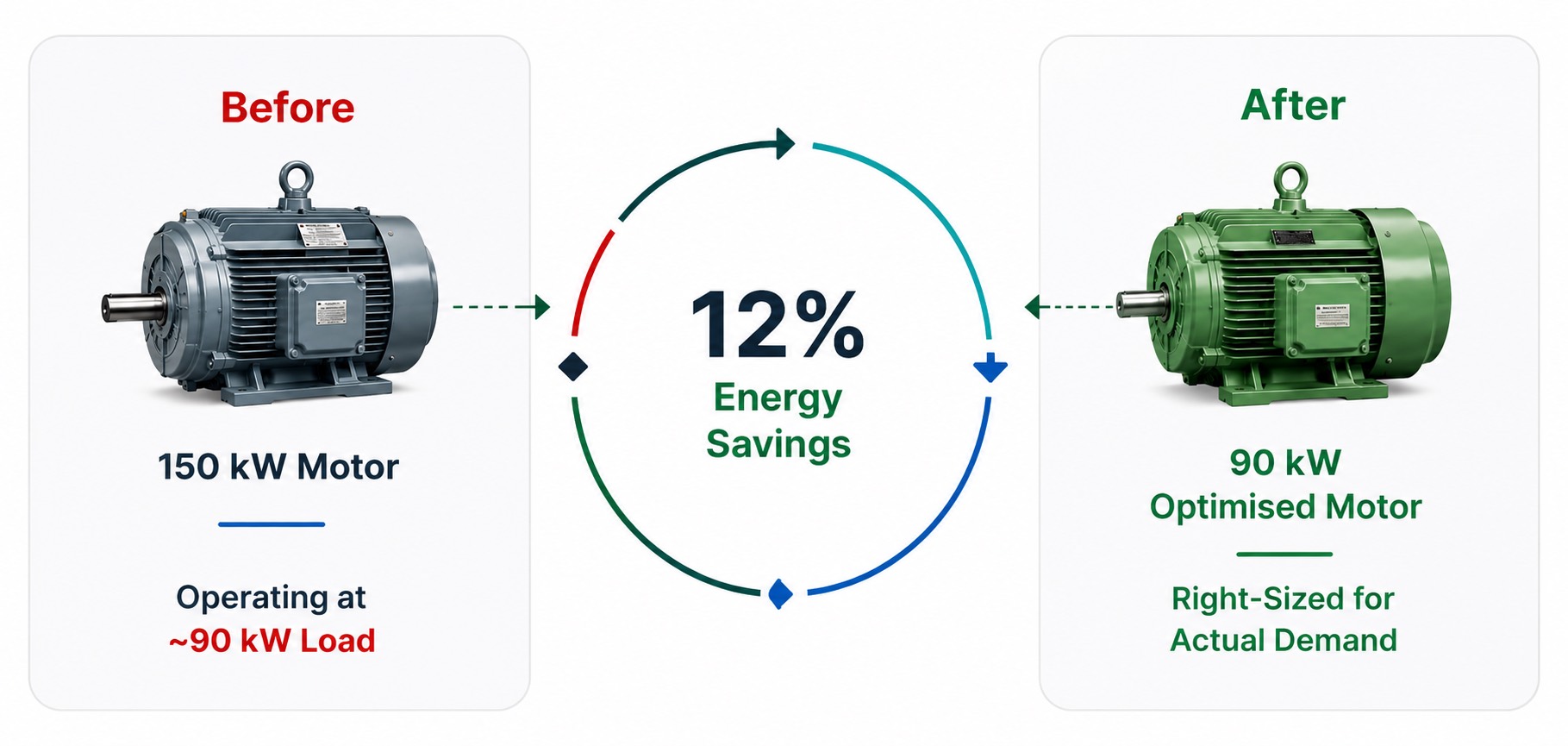
The Sandur mining company, like many heavy industrial facilities, faced persistent challenges with auxiliary power consumption. Critical equipment, particularly compressors and cooling water motors were operating inefficiently. Detailed assessments revealed that several motors were significantly over-rated for their actual load requirements, leading to:

Excessive energy losses (low load factor operation).
Higher monthly electricity bills without proportional output.
Increased carbon footprint and maintenance overhead.
Reduce auxiliary power without altering plant generation or load.
Improve energy efficiency while maintaining 100% system reliability.
Execute quickly during a limited shutdown window.
Ensure safety compliance throughout the retrofit.
Key Results & Delivered KPIs
The project exceeded all clients expectations. Below are the validated outcomes

8 - 12%
Reduction Achieved

+18 %
68 - 72% to 86 - 91%

Safe
Zero Breakdowns

Lower
Carbon Footprint
Our Solution
A 4-Phase Motor Downsizing & Optimization Strategy
AVR Energies implemented a structured 8-week methodology to right-size auxiliary motors using real load data ensuring 100% system reliability while delivering measurable energy savings.
Swipe or use arrows to explore all phases
Phase
Week 3–4

Assessment & Data Analysis
A comprehensive load study and SCADA/DCS data analysis was conducted to establish actual motor utilization across all auxiliary systems.
- Full auxiliary power load study across compressors and cooling water motors.
- SCADA/DCS historical data analysis to identify over-rated equipment.
- Baseline efficiency mapping for all targeted motor assets.
Phase
Week 3–4

Engineering & Planning
Detailed engineering calculations and safety compliance checks were performed to validate every proposed motor change before execution.
- Safety and regulatory compliance review for all retrofit activities.
- Motor re-rating calculations based on verified load requirements.
- Shutdown execution plan aligned with the 7-day plant window.
Phase
Week 5

Execution During Planned Shutdown
Motor replacements and precision alignments were executed within the planned 7-day shutdown window with zero safety incidents.
- Replacement of over-rated motors across identified auxiliary systems.
- Precision alignment and commissioning of all new motor units.
- Real-time coordination with plant operations throughout shutdown.
Phase
Week 6–8
Monitoring & Optimization
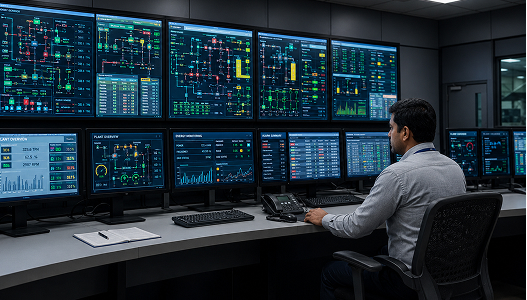
A 3-week intensive monitoring phase verified performance under varying load conditions and fine-tuned systems for sustained efficiency.
- Continuous performance monitoring via SCADA integration.
- Load verification under peak and off-peak operating conditions.
- Final optimization adjustments to maximize long-term savings.
Before & After KPI Comparison
The project exceeded all client expectations. Below are the validated outcomes:
Scroll to view all columns
Why This Matters for Your Plant
The Sandur Plant case study proves that auxiliary power optimization is not about reducing production or adding complex new systems. It is about right-sizing existing assets using real load data.