
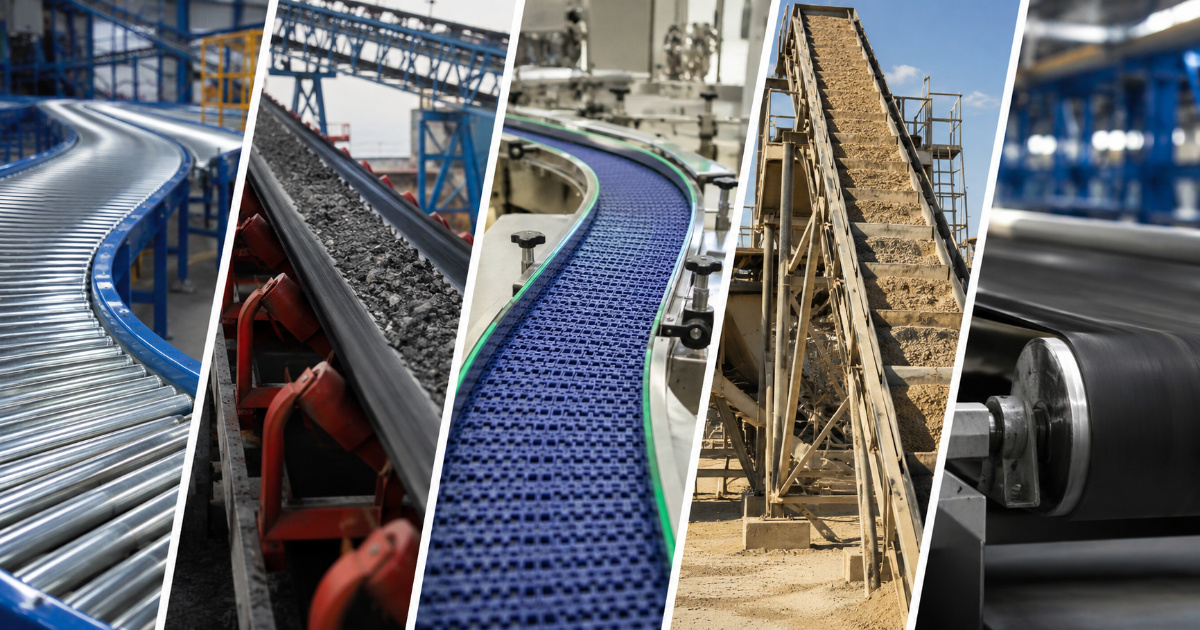
Conveyor belts play an important role in modern industries. They help move materials quickly, safely, and efficiently from one place to another. Industries such as power plants, cement factories, mining, food processing, and manufacturing.
Each Industry requires different types of conveyor belts depending on the material, working environment, and production process. Below are the most common types of conveyor belts explained in simple and easy-to-understand language.
Flat Belt Conveyor
A flat belt conveyor is the most commonly used conveyor system. It uses a continuous flat belt to transport materials from one point to another.
Features
Simple design
Easy to maintain
Suitable for light and medium loads
Applications
Packaging industries
Warehouses
Assembly lines
Power plants
Roller Bed Conveyor
This conveyor uses rollers placed under the belt to reduce friction while moving heavy materials.
Features
Handles heavy loads easily
Reduces power consumption
Smooth material movement
Applications
Airports
Logistics centers
Mining industries
Modular Belt Conveyor
Modular conveyors use interlocking plastic pieces instead of a single continuous belt.
Features
Strong and durable
Easy to clean and repair
Resistant to chemicals and moisture
Applications
Food processing
Pharmaceutical industries
Packaging plants
Cleated Belt Conveyor
Cleated conveyors have raised sections called cleats on the belt surface. These cleats prevent materials from sliding backward.
Features
Ideal for inclined transport
Prevents material spillage
Suitable for loose materials
Applications
Agriculture
Mining
Cement plants
Curved Belt Conveyor
Curved conveyors are designed to move materials around corners and save space in production areas.
Features
Flexible design
Smooth directional changes
Space-saving solution
Applications
Airports
Warehouses
Parcel handling systems
Troughed Belt Conveyor
In this conveyor, the belt forms a trough shape using special rollers. This design helps carry bulk materials efficiently.
Features
High carrying capacity
Prevents material loss
Suitable for long-distance transport
Applications
Coal handling plants
Mining industries
Cement factories
Incline/Decline Belt Conveyor
These conveyors move materials upward or downward between different levels.
Features
Efficient vertical movement
Saves manual labor
Can handle different product sizes
Applications
Packaging industries
Warehouses
Distribution centers
Sanitary/Washdown Conveyor
Sanitary conveyors are specially designed for industries that require high cleanliness standards.
Features
Easy to wash and sanitize
Corrosion-resistant materials
Hygienic design
Applications
Food industries
Beverage plants
Pharmaceutical manufacturing
Magnetic Belt Conveyor
Magnetic conveyors use magnets to move ferrous or metal materials safely.
Features
Secure handling of metal parts
Prevents material slipping
Suitable for sharp metal objects
Applications
Recycling plants
Automotive industries
Metalworking factories
Vacuum Belt Conveyor
Vacuum conveyors use suction to hold products firmly on the belt during transportation.
Features
Prevents product movement
Ideal for lightweight materials
Accurate positioning
Applications
Printing industries
Electronics manufacturing
Packaging systems
Sandwich Belt Conveyor
This system uses two belts to hold materials tightly during steep incline transport.
Features
Handles steep angles
Prevents material falling
Efficient for bulk materials
Applications
Mining industries
Construction projects
Cement plants
Pipe/Tube Conveyor
Pipe conveyors form the belt into a pipe shape to completely enclose materials during transportation.
Features
Prevents dust pollution
Protects materials from weather
Environment-friendly solution
Applications
Power plants
Mining operations
Wire Mesh Conveyor
Wire mesh conveyors are made from metal mesh and are suitable for high-temperature applications.
Features
Heat resistant
Good airflow
Strong and durable
Applications
Baking industries
Drying systems
Heat treatment plants
Industry-wise Quick Mapping of Conveyor Belt Types
|
Industry |
Common Conveyor Belt Types |
Applications |
|
Mining Industry |
Troughed Belt Conveyor, Steel Cord Belt, Sidewall Conveyor, Pipe Conveyor |
Transportation of coal, ores, minerals, and bulk materials over long distances |
|
Food Processing Industry |
PU Conveyor Belt, Modular Belt Conveyor, Hygienic Conveyor, Wire Mesh Conveyor |
Food handling, packaging, baking, cooling, and processing operations |
|
Warehousing & Logistics |
Flat Belt Conveyor, Roller Bed Conveyor, Telescopic Conveyor |
Parcel handling, sorting, loading, unloading, and warehouse automation |
|
Airport Industry |
Curved Belt Conveyor, Flat Belt Conveyor, Baggage Conveyor System |
Baggage handling, security screening, and luggage transportation |
|
Automotive Industry |
Chain Conveyor, Slat Conveyor, Timing Belt Conveyor |
Vehicle assembly lines and movement of automotive components |
|
Cement Industry |
Heat Resistant Conveyor Belt, Troughed Belt Conveyor |
Handling of clinker, limestone, cement, and other bulk materials |
|
Agriculture Industry |
Cleated Belt Conveyor, Chevron Belt Conveyor, Bucket Conveyor |
Grain handling, seed transportation, fertilizer movement, and crop processing |
|
Pharmaceutical Industry |
PU Conveyor Belt, Hygienic Conveyor, Anti-static Conveyor Belt |
Safe and contamination-free transportation of medicines and packaging materials |
|
Electronics Industry |
Timing Belt Conveyor, Anti-static Conveyor, Vacuum Conveyor |
Precise handling of sensitive electronic components and assemblies |
Conveyor Belt Classification by Material
Conveyor belts are manufactured using different materials to meet the specific requirements of various industries. The selection of conveyor belt material depends on factors such as load capacity, temperature resistance, hygiene standards, chemical exposure, and operational environment.
|
Material Type |
Typical Industrial Use |
Key Features |
|
Rubber Conveyor Belt |
Mining, cement, power plants, and heavy industries |
High strength, abrasion resistance, suitable for heavy-duty applications |
|
PVC Conveyor Belt |
Warehousing, packaging, and logistics industries |
Lightweight, cost-effective, flexible, and suitable for general material handling |
|
PU (Polyurethane) Conveyor Belt |
Food processing and pharmaceutical industries |
Hygienic, oil-resistant, easy to clean, and suitable for food-grade applications |
|
Silicone Conveyor Belt |
High-temperature processing industries |
Excellent heat resistance and non-stick surface properties |
|
PTFE/Teflon Conveyor Belt |
Baking, drying, and high-temperature applications |
Non-stick surface, chemical resistance, and excellent thermal stability |
|
Steel Mesh Conveyor Belt |
Furnaces, ovens, and heat treatment plants |
High temperature resistance, durability, and good airflow circulation |
|
Fabric Conveyor Belt |
General manufacturing and light-duty material handling |
Flexible, economical, and suitable for standard industrial operations |
Key Factors Considered During Conveyor Belt Selection
-
Load carrying capacity
-
Temperature resistance
-
Chemical and oil resistance
-
Hygiene requirements
-
Abrasion and wear resistance
-
Flexibility and durability
Conveyor Belt Classification by Function
|
Function |
Recommended Belt Type |
Typical Applications |
|
Horizontal Transport |
Flat Belt Conveyor |
General material handling, packaging lines, warehouses, and assembly operations |
|
Inclined Transport |
Cleated Belt Conveyor / Chevron Belt Conveyor |
Transportation of materials on inclined surfaces without spillage |
|
Vertical Lifting |
Bucket Conveyor / Sidewall Belt Conveyor |
Vertical movement of bulk materials in mining, cement, and agriculture industries |
|
Precision Movement |
Timing Belt Conveyor |
Accurate and synchronized movement in electronics, automation, and automotive industries |
|
Bulk Material Handling |
Troughed Belt Conveyor / Pipe Conveyor |
Long-distance transportation of coal, ores, grains, and other bulk materials |
|
Hygienic Transport |
Modular Belt Conveyor / PU Conveyor Belt |
Food processing, pharmaceutical manufacturing, and cleanroom applications |
|
Heat Handling |
Wire Mesh Conveyor / PTFE Conveyor Belt |
High-temperature applications such as ovens, furnaces, and drying systems |
Key Benefits of Proper Functional Selection
-
Improved material handling efficiency
-
Reduced product damage and material loss
-
Enhanced operational safety
-
Better process automation
-
Reduced conveyor system maintenance and downtime