
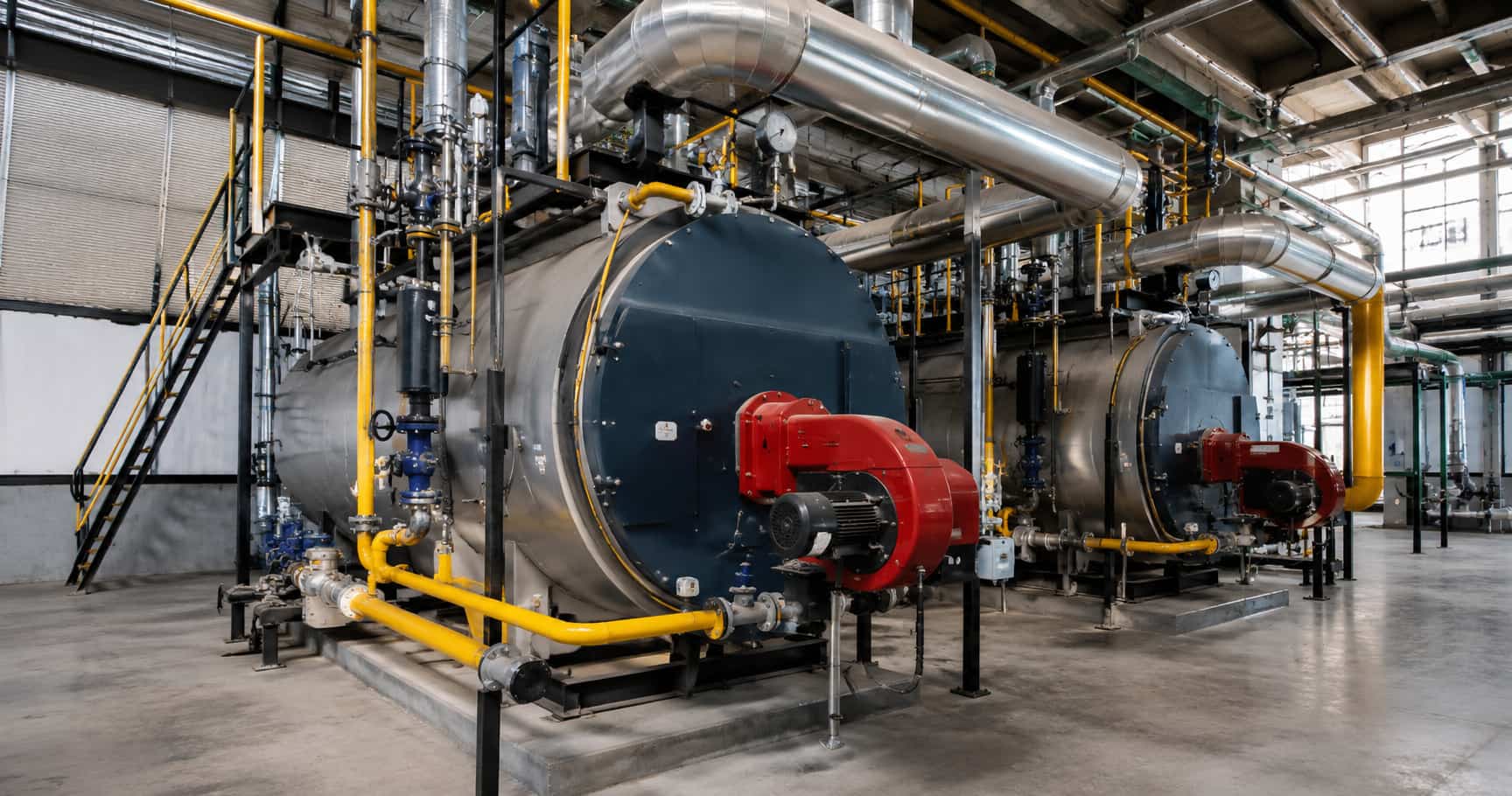
Boiler mountings are essential safety devices that are installed directly on the boiler to ensure its safe operation.
These components help control pressure, monitor water level, regulate steam flow, and protect the boiler from unsafe operating conditions such as overpressure or low water level.
In a thermal power plant, boiler mountings are mandatory because the boiler cannot operate safely without them.
Boiler Mountings List
1. Water Level Indicator
2. Pressure Gauge
3. Safety Valve
4. Steam Stop Valve
5. Feed Check Valve
6. Blow-off Valve (Blow-down Valve)
7. Fusible Plug
8. Manhole
9. Air Vent Valve
Boiler Mounting Functions
Water Level Indicator
The Water Level Indicator is one of the most important boiler mountings. It continuously displays the water level inside the boiler drum, allowing operators to monitor and maintain the correct water level during operation.
Maintaining the proper water level is essential because both low and high water levels can affect boiler performance and safety.
If the water level becomes too low, the boiler tubes may overheat and get damaged. Similarly, if the water level is too high, water may carry over with the steam, reducing steam quality and affecting turbine performance.
Function
-
Shows the water level inside the boiler.
-
Prevents dry firing and overheating.
-
Helps maintain safe boiler operation.
Pressure Gauge
A Pressure Gauge measures the steam pressure inside the boiler. It provides real-time pressure readings, enabling operators to ensure that the boiler is operating within the recommended pressure range.
Continuous pressure monitoring is essential for maintaining safe and efficient boiler operation.
If the pressure exceeds the safe operating limit, corrective action can be taken immediately to prevent equipment damage or accidents.
Function
-
Measures steam pressure.
-
Helps monitor boiler performance.
-
Prevents overpressure conditions.
Safety Valve
The Safety Valve is a critical safety device that protects the boiler from excessive pressure.
It is designed to open automatically when the steam pressure exceeds the preset limit, allowing excess steam to escape safely into the atmosphere.
Once the pressure returns to the normal operating range, the valve closes automatically. This prevents boiler explosions and ensures safe operation.
Function
-
Releases excess steam automatically.
-
Protects the boiler from overpressure.
-
Prevents boiler explosion.
Steam Stop Valve
The Steam Stop Valve controls the flow of steam from the boiler to the main steam pipeline.
It allows operators to start, stop, or regulate the steam supply according to operational requirements.
It is also used to isolate the boiler during maintenance or emergency shutdowns.
Function
-
Controls steam flow.
-
Isolates the boiler during maintenance.
-
Ensures safe steam distribution.
Feed Check Valve
The Feed Check Valve regulates the flow of feedwater into the boiler. It allows water to enter the boiler while preventing reverse flow when the feed pump stops or pressure changes.
Maintaining a continuous and controlled water supply helps ensure efficient steam generation.
Function
-
Controls feedwater entry.
-
Prevents backflow.
-
Maintains proper water level.
Blow-off Valve (Blow-down Valve)
The Blow-off Valve, also called the Blow-down Valve, is installed at the bottom of the boiler. It removes sludge, sediments, and dissolved impurities that settle during boiler operation.
Regular blowdown improves heat transfer, reduces scale formation, and increases boiler efficiency.
Function
-
Removes sludge and sediments.
-
Cleans the boiler.
-
Improves efficiency and equipment life.
Fusible Plug
The Fusible Plug is a safety device designed to protect the boiler from overheating caused by a low water level.
It contains a low-melting-point metal that melts when the boiler temperature becomes excessively high.
When the plug melts, steam and water enter the furnace, reducing the fire and preventing serious boiler damage.
Function
-
Protects against low water level.
-
Prevents overheating.
-
Reduces the risk of boiler damage.
Manhole
A Manhole is an access opening provided in the boiler shell. It allows maintenance personnel to enter the boiler for inspection, cleaning, repair, and overhauling activities.
Without a manhole, internal maintenance of the boiler would be difficult.
Function
-
Provides access for inspection.
-
Facilitates cleaning and maintenance.
-
Supports boiler overhauling.
Air Vent Valve
The Air Vent Valve removes trapped air from the boiler during startup and filling operations.
The presence of air inside the boiler can reduce heat transfer efficiency and cause corrosion.
Removing air ensures better steam formation and improves overall boiler performance.
Function
-
Removes trapped air.
-
Improves steam quality.
-
Prevents corrosion and air locking.
Boiler Accessories
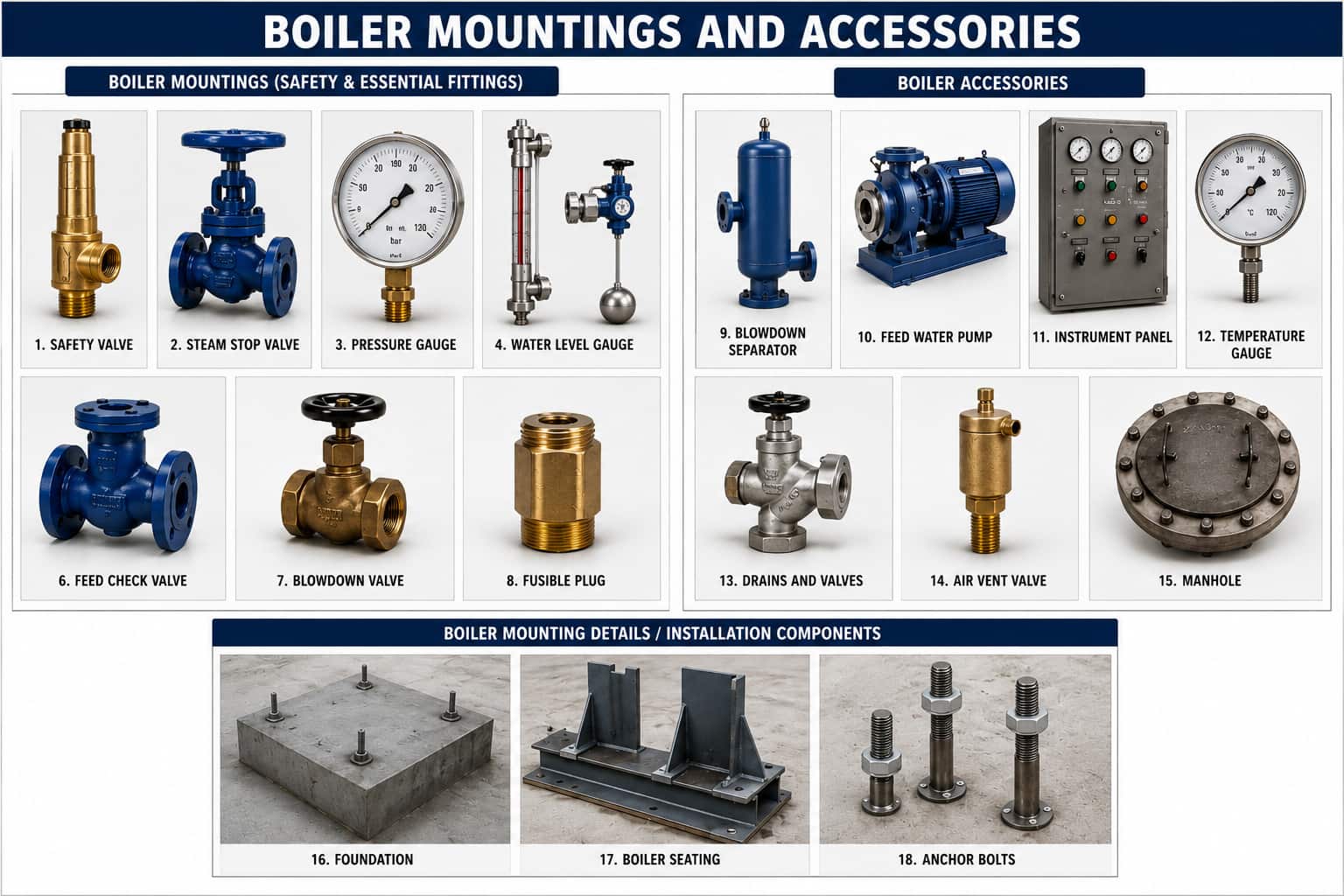
Boiler accessories are auxiliary devices installed with the boiler to improve its efficiency, performance, and steam generation.
They are not essential for the basic operation of the boiler but help reduce fuel consumption, recover waste heat, and improve the overall efficiency of the thermal power plant.
In a thermal power plant, boiler accessories enhance boiler performance, reduce operating costs, and increase plant efficiency.
Boiler Accessories List
Some common boiler accessories are :
1. Economizer
2. Superheater
3. Air Preheater
4. Feed Water Pump
5. Steam Separator
6. Steam Trap
7. Deaerator
8. Soot Blower
Boiler Accessories Functions
Economizer
An Economizer is one of the most important boiler accessories used in thermal power plants.
It recovers the heat from hot flue gases leaving the boiler and uses it to preheat the feedwater before it enters the boiler drum.
Since the feedwater is already heated, the boiler requires less fuel to produce steam,This process improves boiler efficiency, reduces fuel consumption, and lowers operating costs.
Function
1. Recovers waste heat from flue gases.
2. Preheats feedwater before it enters the boiler.
3. Reduces fuel consumption.
4. Improves boiler efficiency.
Superheater
A Superheater is a heat exchanger that increases the temperature of saturated steam beyond its boiling point without increasing its pressure.
The steam produced is called superheated steam, which contains more energy and less moisture.
Superheated steam improves turbine efficiency, reduces blade erosion, and increases the overall performance of the power plant.
Function
1. Converts saturated steam into superheated steam.
2. Improves turbine efficiency.
3. Reduces steam moisture.
4. Increases power plant performance.
Air Preheater
An Air Preheater uses the heat of outgoing flue gases to warm the incoming combustion air before it enters the furnace. Preheated air helps the fuel burn more efficiently and completely.
This improves combustion efficiency, reduces fuel consumption, and increases the overall efficiency of the boiler.
Function
1. Preheats combustion air.
2. Improves fuel combustion.
Saves fuel.
3. Increases boiler efficiency.
Feed Water Pump
The Feed Water Pump supplies feedwater to the boiler at the required pressure. It ensures a continuous supply of water so that steam generation can continue without interruption.
A reliable feedwater supply from the feed water system is essential for maintaining the correct water level and safe boiler operation.
Function
1. Pumps feedwater into the boiler.
2. Maintains continuous water supply.
3. Supports steam generation.
4. Maintains proper boiler water level.
Steam Separator
A Steam Separator removes moisture droplets from steam before it is supplied to turbines or other process equipment.
Dry steam improves equipment performance and reduces the chances of corrosion and mechanical damage, Using dry steam also increases the efficiency of steam-driven equipment.
Function
1. Removes moisture from steam.
2. Produces dry steam.
3. Protects turbines and equipment.
4. Improves steam quality.
Steam Trap
A Steam Trap automatically removes condensate, air, and other non-condensable gases from the steam system without allowing steam to escape. It helps maintain efficient heat transfer and prevents energy loss.
Steam traps are widely used in steam pipelines and heating systems throughout power plants.
Function
1. Removes condensate automatically.
2. Prevents steam loss.
3. Improves system efficiency.
4. Saves energy.
Deaerator
A Deaerator removes dissolved oxygen and carbon dioxide from feedwater before it enters the boiler. These dissolved gases can cause corrosion in boiler tubes, pipelines, and other equipment.
By removing these gases, the deaerator extends boiler life, reduces maintenance costs, and improves system reliability.
Function
1. Removes dissolved oxygen and carbon dioxide.
2. Prevents corrosion.
3. Improves feedwater quality.
4. Increases boiler life.
Soot Blower
A Soot Blower is used to remove soot, ash, and other deposits from the boiler tubes during operation. Clean heat transfer surfaces improve heat absorption and maintain high boiler efficiency.
Regular soot blowing also reduces maintenance requirements and improves overall boiler performance.
Function
1. Removes soot and ash deposits.
2. Cleans boiler tubes.
3. Improves heat transfer.
4. Maintains high boiler efficiency.
PRV (Pressure Reducing Valve)
A Pressure Reducing Valve (PRV) reduces the steam pressure from a higher level to a lower, controlled level before supplying it to different process equipment.
It automatically maintains a constant outlet pressure even when the inlet pressure changes. A PRV protects downstream equipment from excessive pressure and ensures a safe and stable steam supply.
Function
1. Reduces steam pressure.
2. Maintains constant outlet pressure.
3. Protects downstream equipment.
4. Improves steam system safety.
Difference between boiler mountings and accessories
|
Comparison |
Boiler Mountings |
Boiler Accessories |
|
Definition |
Essential safety devices fitted directly on the boiler to ensure safe operation. |
Auxiliary devices installed with the boiler to improve efficiency and performance. |
|
Purpose |
Protect the boiler and operators from unsafe operating conditions. |
Improve steam generation, heat recovery, and fuel economy. |
|
Requirement |
Mandatory for every boiler |
Optional but highly recommended in modern boilers. |
|
Importance |
Ensure safe and reliable boiler operation. |
Increase efficiency and reduce operating costs. |
|
Location |
Mounted directly on the boiler shell or drum. |
Installed in different parts of the boiler system, such as the flue gas path, feedwater line, or steam line. |
|
Main Function |
Control pressure, monitor water level, regulate steam flow, and prevent accidents. |
Recover waste heat, improve combustion, increase steam quality, and reduce fuel consumption. |
|
Effect if Not Installed |
Boiler operation becomes unsafe and may lead to serious accidents or explosions. |
The boiler can still operate, but with lower efficiency and higher fuel consumption. |
|
Examples |
Water Level Indicator, Pressure Gauge, Safety Valve, Steam Stop Valve, Feed Check Valve, Blow-off Valve, Fusible Plug. |
Economizer, Superheater, Air Preheater, Feed Water Pump, Deaerator, Steam Separator, Steam Trap, Soot Blower. |