
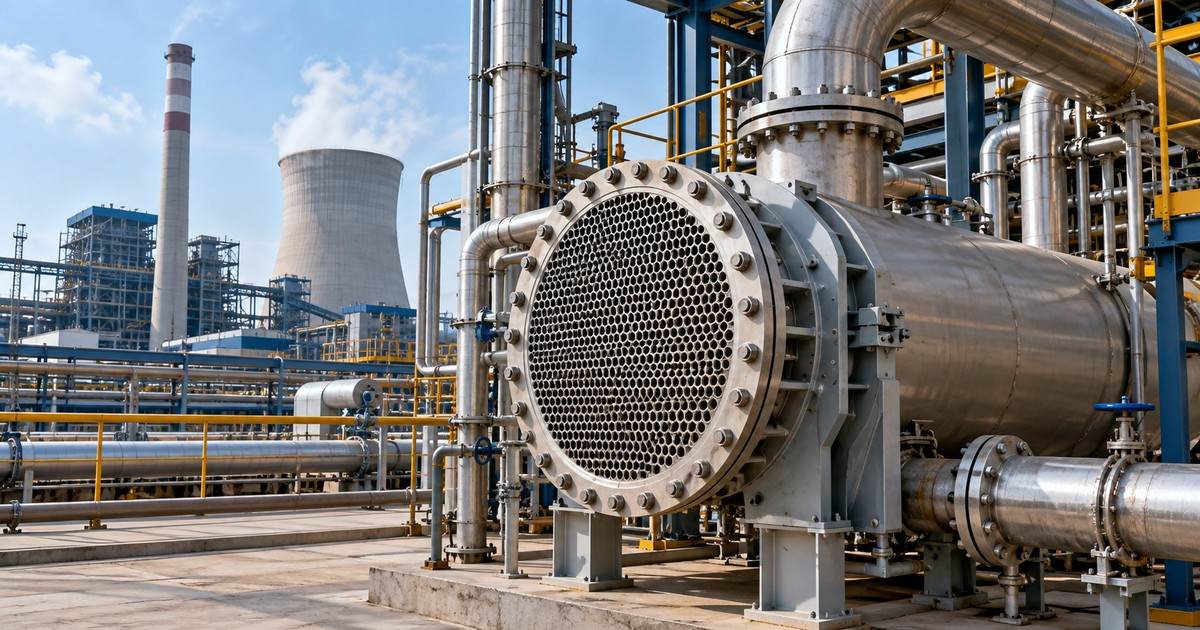
A heat exchanger is a mechanical equipment used to transfer heat from one fluid to another without directly mixing them.
In a thermal power plant, heat exchangers are used for heating, cooling and recovering heat from different fluids such as steam, water, oil and air.
Common examples include feedwater heaters, condensers, lube oil coolers and generator coolers.
Heat exchangers help improve plant efficiency, equipment reliability and heat recovery.
How Does a Heat Exchanger Work in a Thermal Power Plant?
A heat exchanger works by transferring heat from a hot fluid to a cold fluid through a separating surface, usually metal tubes or plates.
The hot fluid flows through one side while the cold fluid flows through another side. Heat passes through the metal surface from the hot fluid to the cold fluid, while the two fluids remain separated.
For example, in a feedwater heater, extraction steam transfers its heat to feedwater, increasing the feedwater temperature before it enters the boiler system.
Basic process
Hot Fluid → Heat Transfer Surface → Cold Fluid
Heat Transfer Principle in Power Plant Heat Exchangers
Heat transfer occurs naturally from a higher-temperature fluid to a lower-temperature fluid. In a typical heat exchanger, heat transfer mainly takes place through
1. Convection: Heat transfer between the fluid and the heat-transfer surface.
2. Conduction: Heat transfer through the metal wall.
3. Convection: Heat transfer from the metal surface to the other fluid.
Therefore, the overall process can be represented as
Hot Fluid → Convection → Metal Wall → Conduction → Cold Fluid
The performance of a heat exchanger depends on factors such as temperature difference, fluid flow rate, heat-transfer area and cleanliness of the heat-transfer surface.
Fouling, scaling, corrosion and reduced flow can decrease heat-transfer performance, so regular monitoring and maintenance are important.
Hot and Cold Fluid Flow Through a Heat Exchanger
In a heat exchanger, the hot fluid and cold fluid flow through separate passages. Heat transfers from the hot fluid to the cold fluid through the separating wall.
The direction of flow between the two fluids affects the heat-transfer efficiency. Based on flow arrangement, heat exchangers are mainly classified as parallel-flow, counter-flow and cross-flow.
Counter-Flow, Parallel-Flow and Cross-Flow Heat Exchangers
1. Counter-Flow Heat Exchanger
In a counter-flow arrangement, the hot and cold fluids flow in opposite directions.
Hot Fluid → → →
← ← ← Cold Fluid
This arrangement generally provides efficient heat transfer and is widely used in industrial applications.
2. Parallel-Flow Heat Exchanger
In a parallel-flow arrangement, the hot and cold fluids flow in the same direction.
Hot Fluid → → →
Cold Fluid → → →
Both fluids enter from the same side and flow together in the same direction.
3. Cross-Flow Heat Exchanger
In a cross-flow arrangement, the hot and cold fluids flow perpendicular to each other.
Hot Fluid → → →
↓
↓ Cold Fluid
Cross-flow arrangements are commonly used where one fluid, such as air, flows across tubes carrying another fluid.
Why Are Heat Exchangers Used in Thermal Power Plants?
Heat exchangers are important in thermal power plants because they help transfer, recover and control heat between different fluids.
They are mainly used for
1. Heating feedwater before it enters the boiler.
2. Cooling lubricating oil and other equipment.
3. Condensing steam into water.
4. Cooling generators and auxiliary equipment.
5. Recovering waste heat to improve plant efficiency.
By using heat exchangers, the plant can reduce heat losses and maintain important equipment within its required operating temperature.
Heat Recovery and Energy Transfer
Heat recovery means using heat from a hot fluid that would otherwise be wasted. In thermal power plants, this recovered heat can be transferred to another fluid and reused in the process.
For example, extraction steam can transfer its heat to feedwater through a feedwater heater. This increases the feedwater temperature and reduces the energy required in the boiler.
Therefore, heat exchangers help achieve better energy utilization, improved efficiency and reliable operation of the thermal power plant.
Feedwater Heating
Heat exchangers are used to increase the temperature of feedwater before it enters the boiler. In feedwater heaters, extraction steam transfers its heat to the feedwater.
Preheating the feedwater reduces the heat required inside the boiler and helps improve the overall efficiency of the power plant.
Cooling and Condensation
Heat exchangers are used for cooling and condensation in thermal power plants.
For example, a surface condenser uses cooling water to remove heat from exhaust steam and convert it into water. Similarly, oil coolers and generator coolers remove unwanted heat from equipment.
Proper cooling helps maintain equipment at its required operating temperature and ensures reliable operation.
Improving Thermal Efficiency
Heat exchangers improve thermal efficiency by recovering and reusing heat that would otherwise be lost.
For example, feedwater heating using extraction steam increases the temperature of feedwater before it reaches the boiler. This reduces the amount of additional heat required in the boiler.
Thus, effective use of heat exchangers helps in better energy utilization, reduced heat losses and improved plant efficiency.
Types of Heat Exchangers Used in Power Plants
Thermal power plants use different types of heat exchangers depending on the application, fluid properties, temperature, pressure and required heat-transfer capacity. Common types include shell-and-tube, plate, surface condenser, air-cooled and regenerative heat exchangers.
Shell-and-Tube Heat Exchangers
A shell-and-tube heat exchanger consists of a bundle of tubes enclosed inside a shell. One fluid flows through the tubes, while the other flows around the tubes inside the shell.
They are widely used in power plants because they are strong, reliable, and suitable for high-temperature and high-pressure applications.
Shell-and-tube heat exchangers are commonly used for cooling and heat-transfer applications in thermal power plants.
Typical applications include
1. Lubricating oil cooling
2. Generator cooling
3. Boiler feed pump cooling
4. Cooling-water systems
5. Various auxiliary equipment cooling systems
During operation, one fluid flows through the tubes while the other flows through the shell side. Heat passes through the tube walls from the hot fluid to the cold fluid.
Plate Heat Exchangers
Plate heat exchangers use a series of thin metal plates to transfer heat between two fluids. The fluids flow through alternate passages between the plates.
They are compact, efficient and easy to clean, making them suitable for many auxiliary cooling applications.
Surface Condensers
A surface condenser converts exhaust steam from the turbine into condensate by transferring heat to cooling water.
The steam and cooling water remain separated, which allows the condensate to be recovered and reused in the boiler cycle.
Air-Cooled Heat Exchangers
Air-cooled heat exchangers use ambient air as the cooling medium instead of cooling water.
Fans force air over tubes carrying the hot fluid, removing heat from the fluid. They are useful where cooling-water availability is limited.
Regenerative Heat Exchangers
Regenerative heat exchangers recover heat from a hot fluid and use it to heat another fluid in the feed water cycle.
In thermal power plants, regenerative feedwater heating uses turbine extraction steam to preheat feedwater before it enters the boiler. This helps improve the overall thermal efficiency of the plant.
Heat Exchanger Applications in a Thermal Power Plant
Heat exchangers are used in many sections of a thermal power plant for feedwater heating, condensate heating, steam condensation, lubricating oil cooling, generator cooling, turbine auxiliary cooling, boiler feed pump cooling, cooling water systems, drain cooling, heat recovery, air and gas cooling and equipment cooling.
They help maintain operating temperatures, recover useful heat, reduce energy losses and improve the overall efficiency and reliability of the plant.
Feedwater Heating Systems
Feedwater heaters use extraction steam from the turbine to increase the temperature of boiler feedwater.
Preheating the feedwater means the boiler requires less additional heat to convert water into steam. This improves heat utilization and helps increase the overall thermal efficiency of the power plant.
Feedwater heaters are generally classified as Low-Pressure (LP) Feedwater Heaters and High-Pressure (HP) Feedwater Heaters.
Condensate Systems
After steam expands through the turbine, the exhaust steam enters the surface condenser, where it is cooled and converted back into water called condensate.
The condensate is collected in the hotwell and then pumped through the condensate extraction system toward the boiler. During this process, heat exchangers such as low-pressure feedwater heaters are used to transfer heat from turbine extraction steam to the condensate.
As the condensate passes through these heaters, its temperature increases before it reaches the next stage of the feedwater system.
This helps recover heat that would otherwise be lost and reduces the amount of heat required in the boiler.
The basic flow can be represented as
Turbine Exhaust Steam → Surface Condenser → Hotwell → Condensate extraction Pump → LP Feedwater Heaters → Deaerator → Boiler Feed System
Boiler and Steam Systems
In a thermal power plant, water and steam continuously circulate through the boiler, turbine, condenser and feedwater systems.
Heat exchangers are used at different points in this cycle to transfer and recover heat efficiently.
Basic Boiler and Steam Flow Path
Boiler → Superheaters → Main Steam → Steam Turbine → Exhaust Steam → Surface Condenser → CEP → LP Feedwater Heaters → Deaerator → Boiler Feed Pump → HP Feedwater Heaters → Economizer → Boiler
Role of Heat Exchangers in the System
1. Economizer : Recovers heat from flue gas to preheat boiler feedwater before it enters the boiler.
2. Superheater : Transfers heat from hot flue gas to steam to produce superheated steam.
3. Feedwater Heaters : Use extraction steam from the turbine to increase the temperature of feedwater.
4. Surface Condenser : Removes heat from turbine exhaust steam and converts it into condensate without mixing it with cooling water.
5. Cooling Systems : Heat exchangers are also used for cooling lubricating oil, equipment, and other auxiliary fluids.
Turbine Auxiliary Cooling
Turbine auxiliary equipment generates heat during operation. Heat exchangers such as oil coolers and water coolers remove this heat and maintain equipment within its required operating temperature.
Proper cooling helps improve the reliability of bearings, pumps and other auxiliary equipment.
Lubricating Oil and Equipment Cooling
Lubricating oil coolers remove heat from hot oil using cooling water or another cooling medium.
They are commonly used for turbine bearings, generator bearings, pumps and other rotating equipment. Maintaining proper oil temperature is important for effective lubrication and equipment protection.
Common Heat Exchanger Problems and Failures
Common problems include
1. Fouling and scaling
2. Tube leakage
3. Tube blockage
4. Corrosion and erosion
5. Tube vibration
6. Gasket failure
7. Reduced heat-transfer performance
8. Excessive pressure drop
9. Air ingress in condenser systems
Early detection and proper maintenance help prevent these problems from developing into major equipment failures and improve the reliability and efficiency of the thermal power plant.
Heat Exchanger Efficiency and Performance in Power Plants
The performance of a heat exchanger depends on factors such as temperature difference, fluid flow rate, heat-transfer area and cleanliness of the heat-transfer surface.
Fouling, scaling, corrosion, tube blockage, air ingress and reduced flow can reduce heat-transfer performance.
Regular monitoring of inlet and outlet temperatures, flow rates, pressure drop and equipment condition helps identify performance problems and maintain efficient operation.
Heat Exchanger Effectiveness vs Efficiency
Heat exchanger effectiveness indicates how effectively a heat exchanger transfers the available heat compared with the maximum possible heat transfer.
Efficiency is often used more generally to describe how well the heat exchanger performs under actual operating conditions.
In power-plant operation, parameters such as temperature difference, flow rate, heat duty and pressure drop are commonly monitored to evaluate performance.
Factors Affecting Heat Exchanger Performance
The main factors affecting heat exchanger performance are:
1. Temperature difference between the fluids
2. Flow rate of hot and cold fluids
3. Heat-transfer area
4. Fluid properties
5. Fouling and scaling
6. Tube condition and blockage
7. Pressure drop
8. Heat-transfer surface condition
Heat transfer area is the surface through which heat passes from one fluid to another.
A larger effective heat-transfer area generally allows more heat to be transferred. In shell-and-tube heat exchangers, the tube surfaces provide the main heat-transfer area.
How to Improve Thermal Power Plant Heat Exchanger Performance
Heat exchanger performance can be improved by
1. Maintaining proper flow rates
2. Keeping heat-transfer surfaces clean
3. Controlling fouling and scaling
4. Maintaining proper cooling-water quality
5. Monitoring inlet and outlet temperatures
6. Checking pressure drop regularly
7. Detecting tube leakage early
8. Following a proper preventive-maintenance schedule
Continuous monitoring helps identify performance degradation before it becomes a major problem.
How to Improve Heat Exchanger Efficiency
Heat exchanger performance can be improved by
1. Maintaining proper fluid flow rates
2. Keeping heat-transfer surfaces clean
3. Controlling fouling and scaling
4. Maintaining proper temperature conditions
5. Inspecting tubes for leakage or blockage
6. Maintaining proper cooling-water quality
7. Monitoring temperature and pressure differences regularly
Heat Exchanger Fouling in Thermal Power Plants
Fouling is the unwanted accumulation of deposits or unwanted material on the heat-transfer surface.
It is a common problem in thermal power plants, especially in cooling-water systems, condensers, and feedwater systems.
Fouling increases thermal resistance and reduces the ability of the heat exchanger to transfer heat.
What Causes Fouling in Heat Exchangers?
Common causes
1. Scaling due to dissolved minerals
2. Corrosion products
3. Suspended particles and dirt
4. Biological growth in cooling-water systems
5. Oil or other contaminants
6. Poor water treatment
7. Low or improper fluid velocity
Effects of Fouling on Heat Transfer and Efficiency
Fouling creates an additional layer of thermal resistance on the heat-transfer surface. As fouling increases:
It can also cause
1. Reduced heat-transfer rate
2. Higher outlet temperature of the fluid that should be cooled
3. Increased pressure drop
4. Higher pumping requirements
5. Reduced condenser vacuum in severe cases
6. Increased maintenance requirements
How to Detect Heat Exchanger Fouling
Heat exchanger fouling can be detected by monitoring changes in operating parameters. Common signs include
1. Increase in temperature difference or reduced heat transfer
2. Increase in pressure drop
3. Reduced cooling or heating performance
4. Reduced cooling-water flow
5. Abnormal changes in outlet temperature
Methods to Reduce and Prevent Fouling
Fouling can be reduced by
1. Maintaining proper cooling-water quality
2. Using suitable water-treatment methods
3. Maintaining adequate fluid velocity
4. Regularly monitoring pressure and temperature
5. Preventing dirt and suspended particles from entering the system
6. Carrying out cleaning at suitable intervals
Heat Exchanger Maintenance and Cleaning
Maintenance is necessary to maintain heat-transfer performance and equipment reliability.
Typical maintenance activities include
1. Visual inspection of tubes, shell, tube sheets, gaskets and connections.
2. Performance monitoring of inlet/outlet temperature, flow rate and pressure drop
3. Tube inspection for leakage, corrosion, erosion and blockage
4. Cleaning of tubes and heat-transfer surfaces to remove deposits
5. Leak testing to identify tube or gasket leakage
6. Thickness measurement where required to check tube or shell condition
7. Checking gaskets and joints for proper sealing
Cleaning may be carried out using mechanical cleaning, water jetting or chemical cleaning, depending on the type of deposit and heat exchanger design.
Heat Exchanger Inspection
Inspection helps identify problems before they cause major failures. Important areas include
1. Tubes and tube sheets
2. Shell and channel
3. Baffles
4. Gaskets and joints
5. Inlet and outlet connections
6. Signs of corrosion, erosion, leakage, or deposits
Temperature, pressure, flow and differential-pressure trends should also be reviewed.
Cleaning Heat Exchanger Tubes
Heat exchanger tubes can accumulate scale, dirt, corrosion products and other deposits.
Depending on the design and condition, cleaning may be performed using
1. Mechanical cleaning
2. Water jet cleaning
3. Chemical cleaning
4. Tube-cleaning equipment
The cleaning method should be selected according to the tube material, deposit type, equipment design and plant maintenance procedure.
Tube Leakage and Tube Plugging
Tube leakage can cause the two fluids to mix, which may affect the quality of the process fluid and damage other equipment.
Tube leakage can be identified through pressure testing, water-quality monitoring, inspection or changes in operating parameters.
If a tube cannot be repaired immediately, it may be plugged to isolate the leaking tube. However, excessive tube plugging reduces the available heat-transfer area and can affect heat exchanger performance.
Preventive Maintenance for Power Plant Heat Exchangers
Preventive maintenance helps maintain the heat-transfer performance, reliability and service life of heat exchangers.
Important maintenance activities include
1. Monitoring temperature, pressure, flow and pressure drop
2. Inspecting tubes, shell, gaskets and connections
3. Checking for leakage, corrosion and fouling
4. Cleaning heat-transfer surfaces when required
5. Inspecting tube thickness and condition
6. Checking vibration and abnormal operating conditions
Heat Exchanger Materials and Components
The material and construction of a heat exchanger depend on the fluid properties, temperature, pressure, corrosion conditions and application.
1. Carbon Steel - Commonly used for shells, channels, and other structural parts.
2. Stainless Steel - Used where better corrosion resistance is required.
3. Copper and Copper Alloys - Used in some cooling-water and heat-transfer applications because of their good thermal conductivity.
4. Aluminium Alloys - Used in selected lightweight and air-cooled applications.
5. Nickel Alloys - Used for high-temperature or highly corrosive applications.
6. Titanium - Used in applications requiring excellent corrosion resistance, particularly with aggressive cooling-water conditions
Major components include the shell, tubes, tube sheets, baffles, gaskets, channels, nozzles and tube bundles.
Heat Exchanger Tubes and Shell
The tubes provide the main heat-transfer surface. One fluid flows through the tubes while the other flows around them.
The shell surrounds the tube bundle and provides the passage for the shell-side fluid. It also provides structural support and contains the operating pressure.
Materials of Construction
Common materials used in heat exchangers include carbon steel, stainless steel, copper alloys and various corrosion-resistant alloys.
The selection depends on factors such as temperature, pressure, fluid composition, corrosion resistance, mechanical strength and cost
Gaskets, Fins and Tube Bundles
Gaskets provide sealing between components and prevent fluid leakage. Fins increase the effective heat-transfer surface area and are commonly used where heat transfer to or from air is required.
The tube bundle consists of multiple tubes arranged together to provide the required heat-transfer area.
Heat Exchanger Design and Selection for Thermal Power Plants
A heat exchanger is selected based on the required heat duty, fluid flow rates, inlet and outlet temperatures, operating pressure, allowable pressure drop and available space.
Other important considerations include
1. Heat-transfer area
2. Material compatibility
3. Fouling tendency
4. Maintenance requirements
5. Expected operating life
6. Safety and reliability
Proper design and selection ensure that the heat exchanger can provide the required performance under actual power-plant operating conditions.
Heat Duty and Heat Transfer Requirements
Heat duty is the amount of heat that a heat exchanger needs to transfer during operation. It is an important parameter for selecting the correct heat exchanger size and design.
The required heat duty depends mainly on the fluid flow rate, specific heat and temperature change.
Flow Rate and Temperature Difference
The flow rate of both hot and cold fluids directly affects heat transfer. A suitable flow rate is required to achieve the desired heat-transfer performance without creating excessive pressure drop.
The temperature difference between the two fluids is also important. A greater temperature difference generally provides a greater driving force for heat transfer.
Heat Transfer Surface Area
The heat-transfer surface is the area through which heat passes from one fluid to another.
If more heat needs to be transferred, a larger effective heat-transfer area may be required. In shell-and-tube heat exchangers, the tube surface provides the main heat-transfer area.
Number of Tubes and Passes
The number of tubes determines the available heat-transfer area and affects fluid velocity.
The number of passes determines how many times the fluid travels through the tube bundle. Increasing the number of passes can increase fluid velocity and heat transfer, but it may also increase pressure drop.
Therefore, the number of tubes and passes must be selected according to the required heat duty, flow rate, pressure drop and equipment design.
Selecting the Right Heat Exchanger Type
The correct heat exchanger type depends on the application and operating conditions.
Important selection factors include
1. Required heat duty
2. Fluid type and properties
3. Temperature and pressure
4. Flow rate
5. Fouling tendency
6. Available space
7. Maintenance requirements
8. Material compatibility